
What studies show about knowledge and onboarding

At a Glance
When onboarding new employees, it's not the volume of information that matters. It's how quickly and independently they can access the knowledge that's already there.
And that's exactly the problem in many mid-sized companies: knowledge is there, but spread across wikis, drives, emails, or the heads of individual employees. New colleagues keep asking the same questions, dig through dozens of documents, or wait for answers from coworkers.
Where knowledge management looks like this, productivity is lost. Knowledge workers spend nearly 20% of their work week searching for internal information or for colleagues who can help.[1] At the same time, it often takes months until new employees work independently. During that time, follow-up questions keep experienced colleagues from their actual work.
The solution is closer than many think: the schnell.digital AI Kit, the AI platform for mid-sized businesses.
An AI agent brings your company knowledge together in one central place, makes it available at any time and supports new employees in their daily work:
They find answers in seconds and become independent faster. HR and team leads are relieved. And even when someone leaves or retires, the knowledge stays in the company.
The example calculation further down shows how big the potential is for you.
Does This Sound Familiar?
A new employee starts at the company. Soon enough, the inevitable begins: the questions. „Where do I find the current customer list?“ „How do I request vacation?“ „Which tool do we use for XY?“
None of this is complicated. But all of it costs time. Because the answers exist somewhere in the company. Just not where they're needed. So what happens is what's daily life in many companies: The new hire has to ask.
Colleagues, HR, the team lead. Which means: others have to interrupt their work just so the new hire can move forward. And the next day? It all starts over.
Meanwhile, the new hire tries to figure things out on their own. They click through wikis, dig through drives, open old documents – and in the end are often still not sure whether the information is even still up to date.
The result: uncertainty for new colleagues. Frustration for HR and team leads. And an onboarding that drags out unnecessarily, costing valuable time and money.
Nearly 20% of the Work Week Spent Searching
Knowledge exists, but is hard to find. As a result, valuable time is lost.[1]
15 to 40 Weeks Until Full Productivity
Depending on prior experience. People coming from another industry need 32 weeks on average.[2]
Knowledge Sits in People's Heads
A large part of your knowledge is not written down in any document. When employees leave, it often leaves with them.
Many Companies Try It This Way:
- –Even more documentation in wikis, intranet, or drives
- –Bloated, outdated onboarding handbooks that hardly anyone reads in full
- –Small automations and chatbots that deliver isolated answers, but don't understand the bigger picture
All of these are steps that may speed up individual things, but they don't solve the actual problem:
Company knowledge sits in the heads of individual employees, in old documents, emails, or scattered across various tools and drives. It's there, but not usable in any structured way.
And that's often the root problem of knowledge management in mid-sized companies:
As long as information isn't centrally available, onboarding stays slow. Because every search starts from scratch. No matter how many tools, documents, or AI experiments you bolt on.
What If:
- new employees no longer had to ask colleagues or HR, but could ask an AI assistant directly?
- answers like „How do I request vacation?“ or „Where do I find the customer list?“ were instantly available?
- HR and team leads no longer had to keep explaining the basics, but could get back to real people work?
The decisive thought is often this:
The knowledge already exists in the company, but in daily life it's hard to grasp. Information is scattered everywhere. A lot of it gets explained or pieced together again and again, instead of just being used.
What's missing is a central place where knowledge is available exactly when it's needed.
Just Imagine ...
There were someone who gave new employees answers to their questions at any time – without colleagues or HR having to interrupt their work?
Someone who made sure information was instantly available – instead of having to be asked for or pieced together?
And someone who, as an AI agent, prepared all of your knowledge so it's understandable, traceable, and accessible to everyone at any time?
Someone like the schnell.digital AI Kit, working in the background.
That's exactly what this is about.
That's exactly why we built schnell.digital AI Kit.
schnell.digital AI Kit in Onboarding
Your Result After Just a Few Weeks
With schnell.digital AI Kit as an AI agent, your knowledge management and your onboarding change noticeably:
New and Existing Employees Find Answers Instantly
Typical questions are clarified directly – no follow-ups to colleagues or HR.
HR and Team Leads Get Their Time Back
Fewer interruptions in daily work. More focus on what really matters.
Knowledge Stays in the Company
Even when employees leave, their know-how stays available and usable at any time.
In short:
- – employees become productive faster
- – HR and team leads are noticeably relieved
- – knowledge no longer retires with people
And above all:
Your knowledge management becomes what it was always supposed to be: a real competitive advantage.
schnell.digital AI Kit takes the load off where onboarding loses the most time.
How schnell.digital AI Kit Steps In
Instead of searching or asking for information again and again, employees get clear answers and orientation instantly. Questions are understood directly by the AI assistant and answered with the right context from your company knowledge.
The basis for this is the knowledge you already have in your company:
- documentation from wikis, intranet, and drives
- onboarding materials and process descriptions
- policies, FAQs, and guides
- the experience knowledge of your employees
schnell.digital AI Kit consolidates this content and makes it centrally usable. The typical onboarding workflows are clearly structured:
Which information does a new employee need, and when?
Which questions keep coming up?
How are answers delivered consistently?
All of this happens in natural language, meaning the employee asks what they're thinking, and the AI agent answers. Simple and easy to understand. No complex prompts, no coding experience required.
Your Result:
Fewer follow-up questions. Faster ramp-up. And teams that can finally use their knowledge efficiently.
Pilot in 6 to 8 weeks. No tool chaos. No big IT project.
Turn knowledge management chaos into a clearly structured onboarding process
01
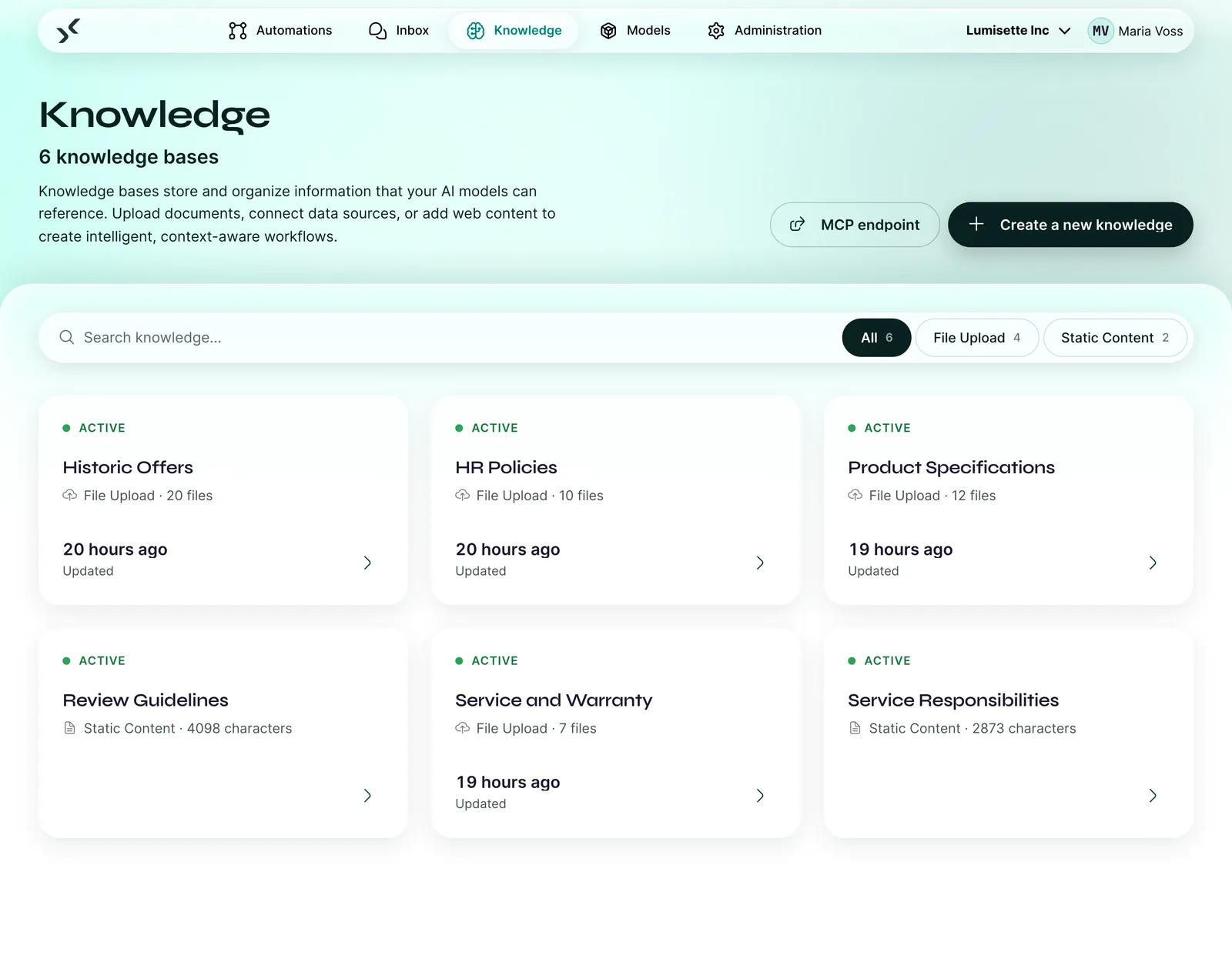
Import and Structure Existing Documentation
Wikis, intranet, drives, and other existing materials are brought together in schnell.digital AI Kit and organized so that knowledge becomes centrally available and quickly findable.
02
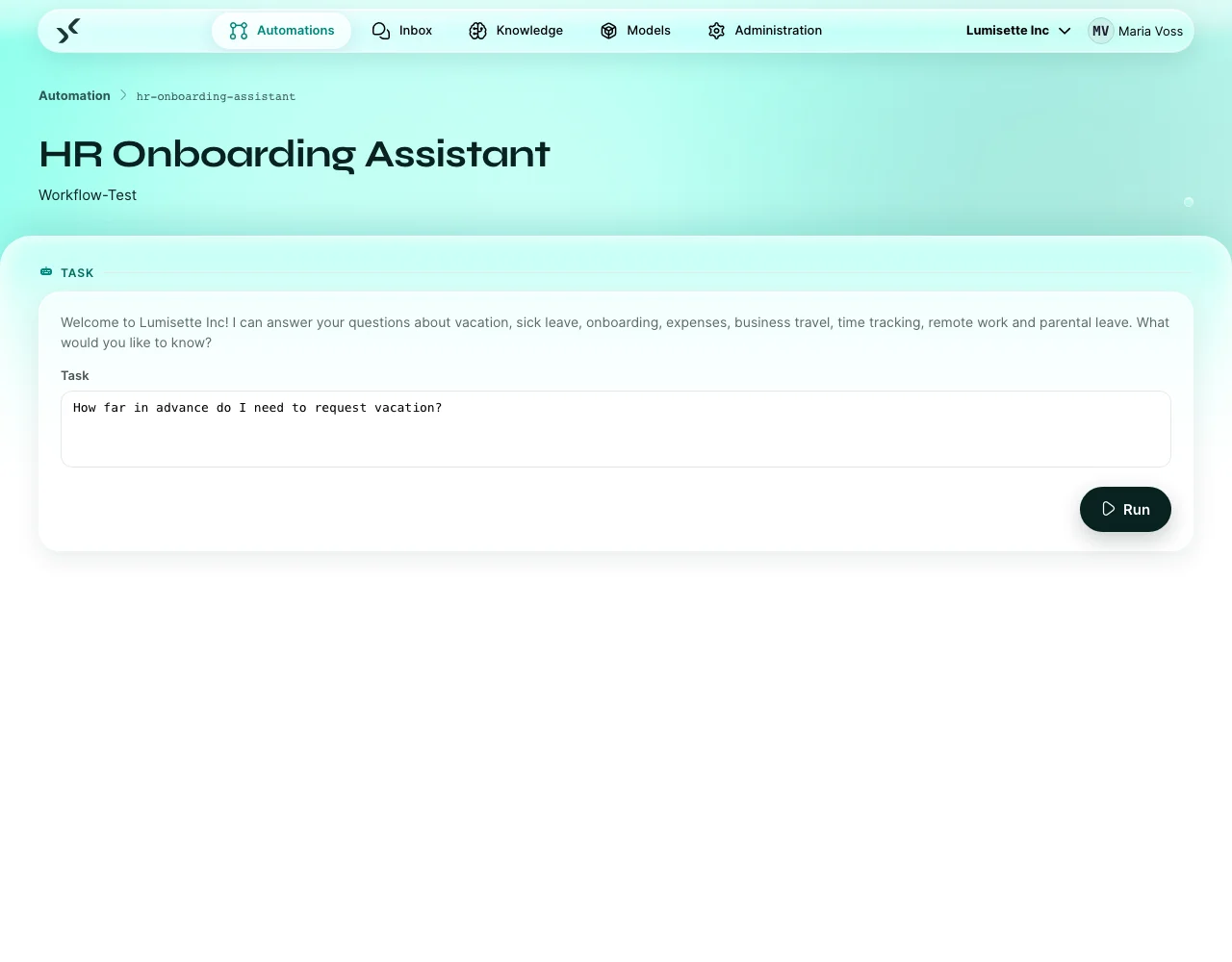
Configure the Onboarding Agent
Typical questions from new employees serve as the starting point. From those, an assistant is built that delivers answers about processes, tools, rules, and workflows directly.
03
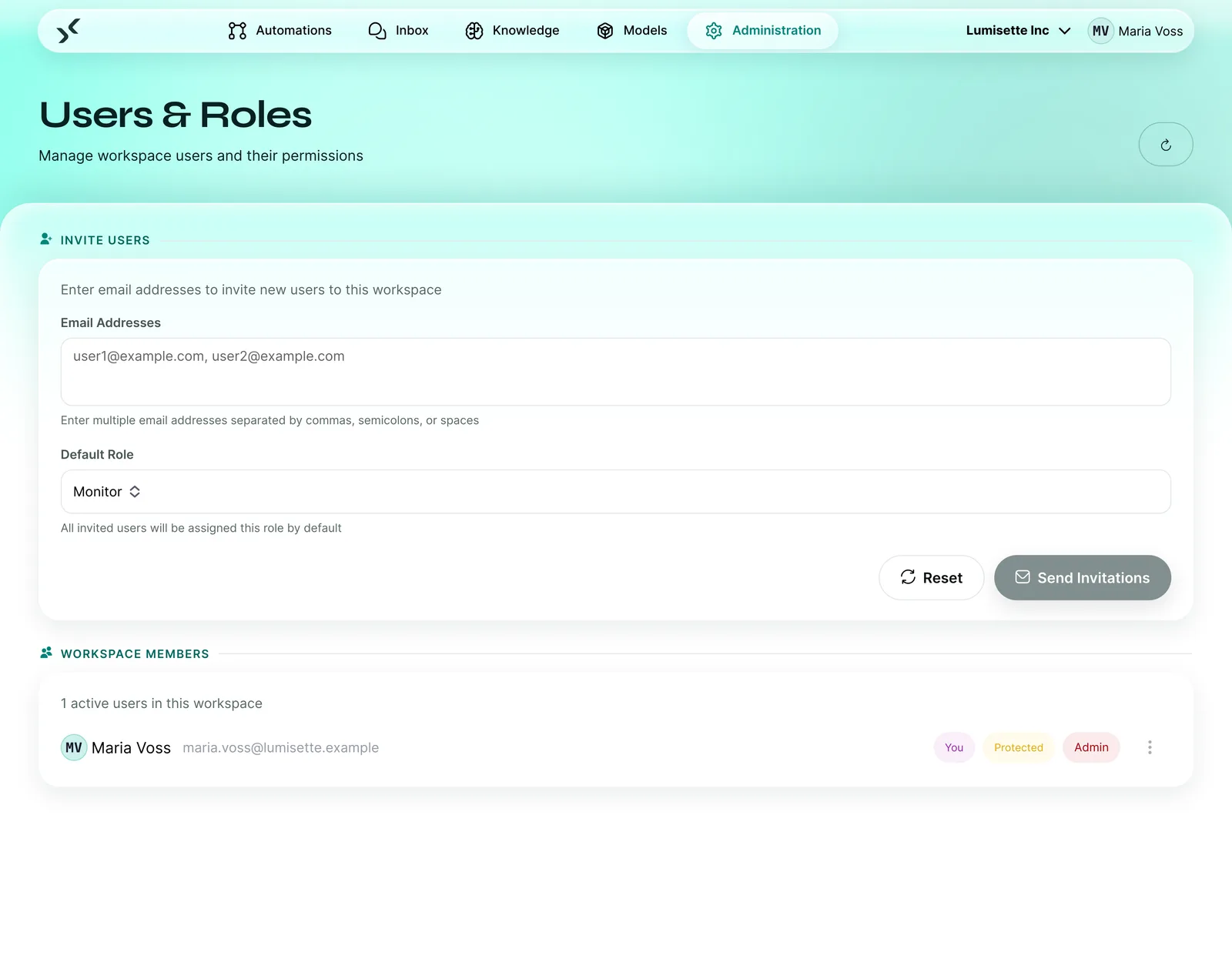
Pilot With One Department, Then Roll Out
We start in a clearly scoped area, identify gaps in daily use, and then roll the system out across the company step by step.
Pilot in 6 to 8 weeks from project start.
What this looks like in the AI Kit
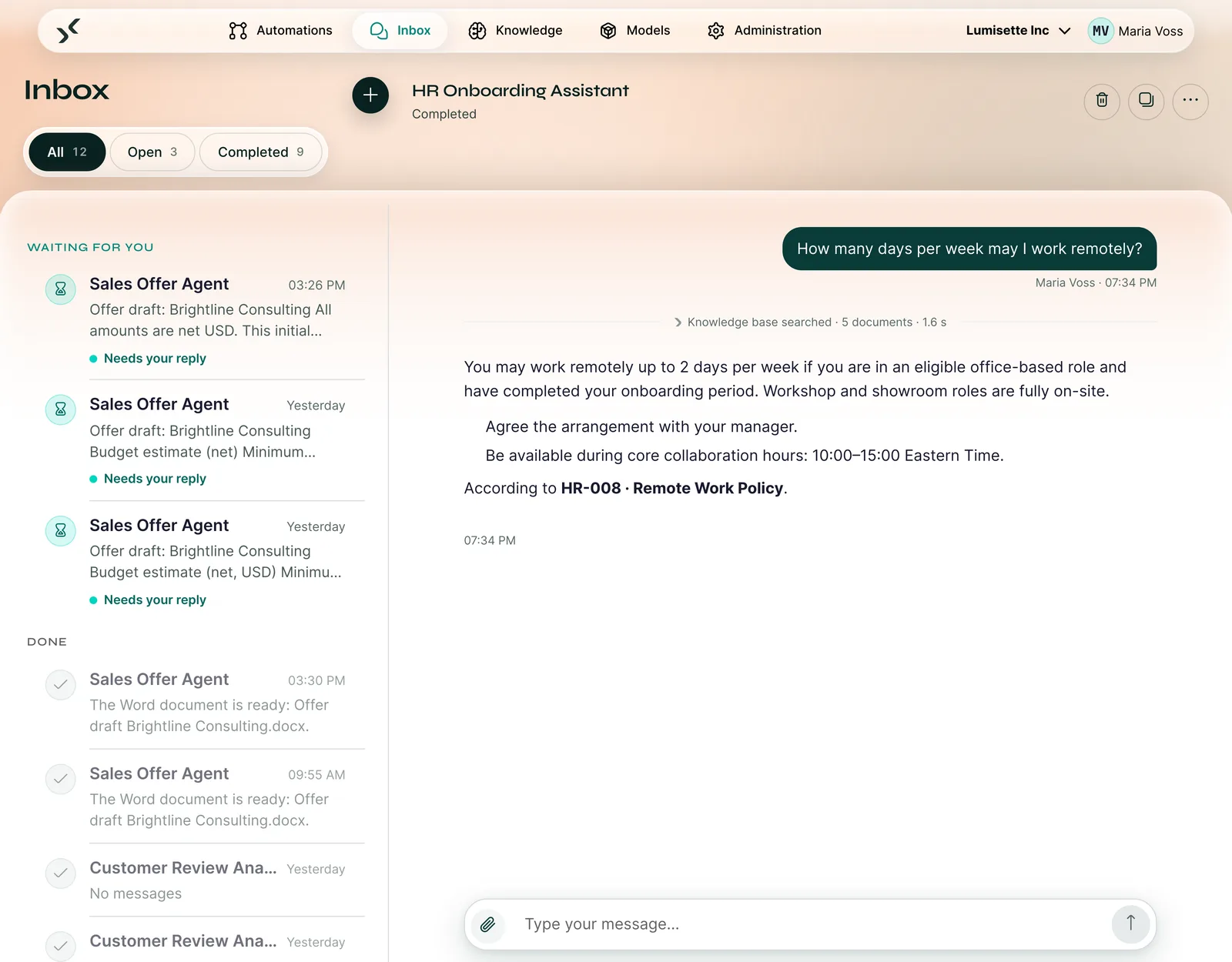
The HR assistant answers from your policies
In the schnell.digital AI Kit, the AI platform for mid-sized businesses, an HR assistant answers new employees’ questions from your own documents: policies, handbooks and FAQs. Every answer names its source, so it is clear where it comes from.
Question from the team
How many days per week may I work remotely?
The assistant answers from the HR policy and names the source
Before and after: onboarding with the schnell.digital AI Kit
| ❌ Starting Point | With schnell.digital AI Kit | ✓ Result |
|---|---|---|
| New employees keep asking the same questions | The AI agent answers typical questions about processes, tools, and policies | Employees find answers on their own and HR is freed up |
| Knowledge is scattered everywhere: wikis, intranet, drives, individual people's heads | Instead of searching and asking, the AI agent delivers context-aware answers | There is one central, always up-to-date knowledge base for all common questions |
| Processes are unclear or hard to follow | Answers are based on stored sources and clear workflows | Instant, traceable answers, with no waiting time |
| Knowledge transfer isn't documented or traceable | Answers name their sources, and runs are logged | You can trace where an answer comes from |
What Does It Cost You NOT to Use schnell.digital AI Kit?
The real question isn't what an AI agent gets you in knowledge management.
It's what it costs you if your onboarding keeps running the way it does today – because knowledge is scattered, hard to find, and only available in the heads of a few employees.
Example calculation with assumptions:
- 200 employees (assumption)
- Avg. €50,000 annual salary (assumption)
- Nearly 20% of working time spent searching for information. The figure applies to knowledge workers, and here we assume it for everyone.[1]
That's around €2 million in working time per year that goes into searching.
A searchable knowledge base can cut this search time by up to 35%.[1]
And that's just the operational side.
The bigger lever is in onboarding.
On top of that come early departures. In the Haufe onboarding survey 2023, 36% of the companies surveyed report resignations between contract signing and the first working day.[3]
According to softgarden, one in six respondents has already quit a job within the first 100 days.[4]
Example calculation with assumptions:
- 10 departures during onboarding per year (assumption)
- Replacement cost per departure: half an annual salary to two annual salaries according to Gallup[5], at an average of €50,000
That's €250,000 to €1 million per year.
A serious loss, caused by bumpy onboarding and a lack of structure in knowledge management.
And there's another dimension that many companies underestimate:
Knowledge loss. When experienced employees leave, their know-how often walks out with them.
An example calculation with assumptions:
- 5 knowledge holders leave the company per year (assumption)
- Cost per departure: one annual salary of €50,000, the middle of the Gallup range[5]
That's around €250,000 per year.
With these assumptions, the opportunity costs are substantial:
- – around €2 million in working time spent searching
- – €250,000 to €1 million from departures during onboarding
- – around €250,000 from knowledge leaving the company
at least €2.5 million
per year, using the assumptions of this example calculation
around €2 million
Working time spent searching per year (example calculation)
With these assumptions, that's at least €2.5 million a year.
Use your own values. The biggest item is almost always the search time.
These opportunity costs aren't theoretical.
They show up in your P&L.
And they grow with every employee who joins or leaves the company.
What Your Onboarding Day Could Look Like with schnell.digital AI Kit ...
Day 1
It's Monday, 8 a.m. Today the new hire starts. The first days run as structured as ever: onboarding plan, first meetings, intros. But this time something feels unusually different. You don't hear it. No: „Where do I find the customer list?“ or „How do I request vacation?“ Because instead of interrupting colleagues or HR at work, the new hire asks the AI agent directly. And gets clear answers immediately – without having to search or wait.
After a Few Days
A few days later the new hire is getting into a process. Before, they would have clicked through several documents or asked again and again. Now they get the relevant information summarized for them directly: understandable, traceable, to the point. The result? They find their way around quickly, get more confident about what to do when, and can work independently in a fraction of the time.
Knowledge Preservation
And then something happens that used to always be tricky: an experienced employee leaves the company. Before, you would have wondered: who still knows how this works? Not this time. Because the knowledge isn't only in their head anymore. It's captured in a structured way and available to everyone – with no dependency on a single person. The next employee can simply tap into it via the AI agent and pick up where the last one left off.
Result
With schnell.digital AI Kit as an AI agent, your daily routine suddenly changes noticeably. Because onboarding has become significantly more relaxed. Fewer „Got a minute?“. Fewer interruptions to your actual job. And suddenly HR and team leads have time again for the things that usually slip through the cracks.
How Much Productivity Are You Losing Because Knowledge Isn't Available?
The 5-Minute Process Check shows you whether there's untapped potential in your knowledge management and how to make your employees productive faster with our AI agent – without extra workload for HR and team leads.
Because an onboarding process that works for everyone is no longer a bonus. It decides how fast new employees become productive, and whether knowledge stays in your company – or walks out the door for good ...
Free · 5 Minutes · No Obligation
Prefer to see the AI Kit live right away? Book a demo →